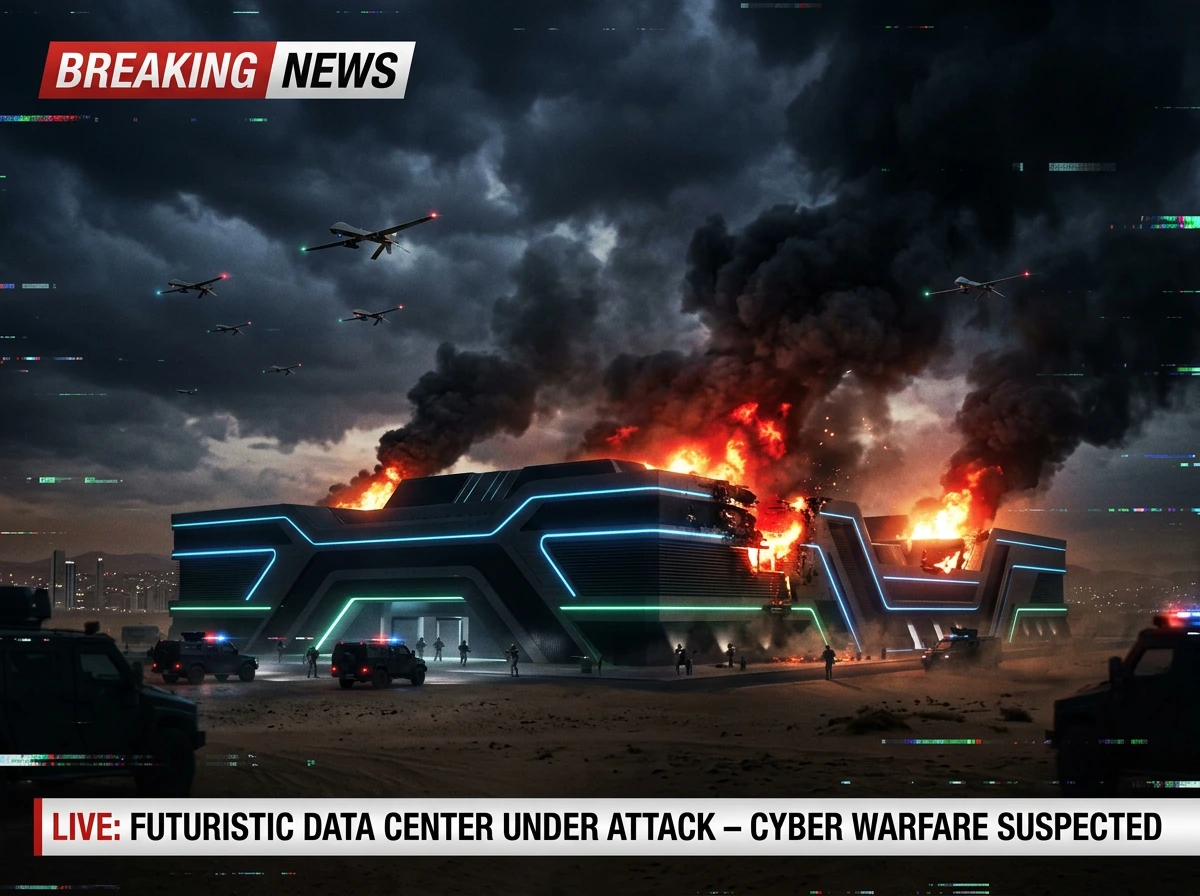
Iranian missiles have hit the Batelco headquarters in Bahrain — which houses Amazon Web Services (Data Center) infrastructure — marking the most aggressive escalation yet in Tehran’s declared campaign against American technology companies in the Gulf.
⚠ SITUATION ALERT
Iran’s Revolutionary Guards publicly warned one day before this strike that they would begin targeting major US tech firms — including Apple, Google, and Meta — if any more Iranian leaders were killed. This attack on the Batelco facility appears to be the first strike executed under that threat.
Iranian missiles have struck the headquarters of Batelco, Bahrain’s largest telecommunications company, in the Hamala district — a facility that also hosts critical Amazon Web Services (AWS) infrastructure. Bahrain’s Interior Ministry confirmed that civil defense teams were responding to a fire at the complex, with reports indicating parts of the facility have been rendered inoperative and Amazon servers inside have been affected.
Must Read:
Google, Facebook, and Amazon most targeted for data theft in 2024: Kaspersky reveals
The strike comes just one day after Iran’s Islamic Revolutionary Guard Corps (IRGC) issued an explicit warning that it would begin targeting the regional offices of major American technology companies. This is being described as the first missile strike carried out directly under that declared policy — representing a significant escalation from the drone strikes that characterised Iran’s earlier campaign against US tech infrastructure in the Gulf region.
“The cloud runs on data centers. Those data centers have an address. And that address can be hit by a missile.”
This is not an isolated incident. On March 1, 2026, Iranian Shahed drones struck two AWS data centers in the United Arab Emirates directly, while a separate AWS facility in Bahrain sustained damage from a nearby explosion. Those earlier attacks — confirmed by Amazon Web Services — forced all three facilities offline and triggered widespread service outages across banking, payment platforms, delivery applications, and enterprise software throughout the Gulf region.
Iran’s IRGC subsequently claimed responsibility for the March strikes, stating the Bahrain facility had been targeted due to Amazon’s support for US military and intelligence operations. Iranian state media agency Fars News reported the attack was launched to identify “the role of these centers in supporting the enemy’s military and intelligence activities.” Amazon confirmed the disruptions but did not immediately comment on whether the latest Bahrain facility was struck directly or damaged by proximity.
The broader implications of this campaign are significant. Seventeen submarine cables pass through the Red Sea, carrying the majority of data traffic between Europe, Asia, and Africa. With Iran’s closure of the Strait of Hormuz and renewed Houthi threats in the Red Sea, both critical data chokepoints are now simultaneously inside active conflict zones — a situation analysts warn has never occurred before in the modern internet era.
The strikes also land at a particularly fraught moment for Gulf ambitions to become a global artificial intelligence hub. US President Donald Trump’s regional tour generated over $2 trillion in investment pledges — including a planned Stargate UAE campus in Abu Dhabi that would have been the largest AI facility outside the United States. The security of physical infrastructure is now a central question that investors and policymakers cannot avoid.
Key Impact Areas
|
🏦 Financial Impact Major banks including Abu Dhabi Commercial Bank, payment firm Hubpay, and consumer apps like Careem all reported service disruptions following AWS outages in the region. |
☁ Cloud Operations Amazon has advised customers to back up data and migrate workloads away from Middle East regions, calling the “broader operating environment unpredictable.” |
|
🛡 Pentagon Exposure The Pentagon’s cloud infrastructure — including AI systems running on commercial AWS networks — could be affected, raising urgent questions about military data security in civilian zones. |
🌐 Internet Chokepoints Both the Strait of Hormuz and Red Sea submarine cable routes are now simultaneously threatened — analysts say this has never happened before in modern internet history. |
Amazon Web Services has not yet issued a detailed statement on today’s missile strike. The company previously told Media that customers with workloads in affected regions should continue to migrate to other locations as the situation evolves. The global technology industry and international policymakers must now confront the reality that data centers are on the front lines of 21st-century warfare — and no amount of digital redundancy can substitute for physical security.