
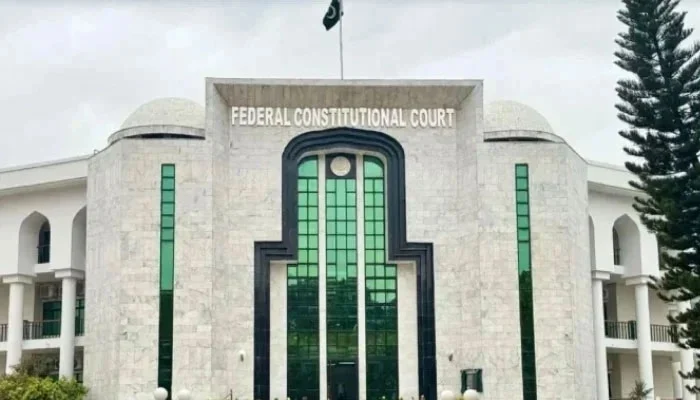
The Federal Constitutional Court (FCC) has issued a definitive, precedent-setting verdict declaring that land acquired for public purpose under the Land Acquisition Act, 1894, cannot be legally repurposed into residential housing societies or private commercial ventures. In a detailed 17-page judgment, the court clarified that the constitutional basis of property acquisition rests entirely on the collective public utility declared at the time of taking.
This major ruling is expected to halt the widespread practice of converting dormant industrial and public lands into lucrative real estate projects across the country.
Retaining Public Character Over Judicial Transfers
The milestone ruling came during an appeal filed by a private international firm challenging a prior Peshawar High Court decision regarding 1,020 kanals of land in Nowshera. The land had originally been acquired by the State in 1954 specifically for setting up Paper and Board Mills. After industrial operations ceased, a private company purchased the territory through a court auction and attempted to develop a residential housing scheme.
Dismissing the appeal, FCC Chief Justice Aminuddin Khan observed that land acquired for public purpose does not simply become ordinary private property over time. The apex court ruled that even if the property is transferred, assigned, or sold via a judicial auction, it remains legally bound by the original public welfare covenants. An auction purchaser merely steps into the shoes of the original allottee and holds no absolute right to alter its usage for private commercial gain.
Legal Constraints and Constitutional Protection
The legal bench, which also included Justice Ali Baqar Najafi, heavily cited Section 41 and Section 43-A of the Land Acquisition Act, 1894. These clauses clearly establish that the sale, lease, mortgage, or shift in the operational nature of state-acquired land is completely voidable without direct, prior sanction from the provincial government.
Furthermore, the court highlighted that Article 24 of the Constitution allows the State to forcibly acquire private property from citizens strictly for the greater public good. If that fundamental objective is abandoned to pave the way for private real estate development, the very constitutional validity of the initial acquisition is compromised.
Alignment With Shariah Principles
Expanding on the ethical dimension of land rights, the court aligned its final findings with Islamic jurisprudence. Shariah principles strongly protect individual private property rights and strictly prohibit the wrongful appropriation of someone’s asset. The judgment noted that using the State’s power of eminent domain to take land for a public benefit, only to later let private developers profit off it, directly violates Islamic rules of justice and fair trade.
Consequently, the court maintained that if any provincial authority finds that acquired land is no longer being used for its sanctioned purpose, the government is fully authorized to intervene under the law to reverse or handle the asset, rather than letting it fall into the hands of commercial housing developers.


