
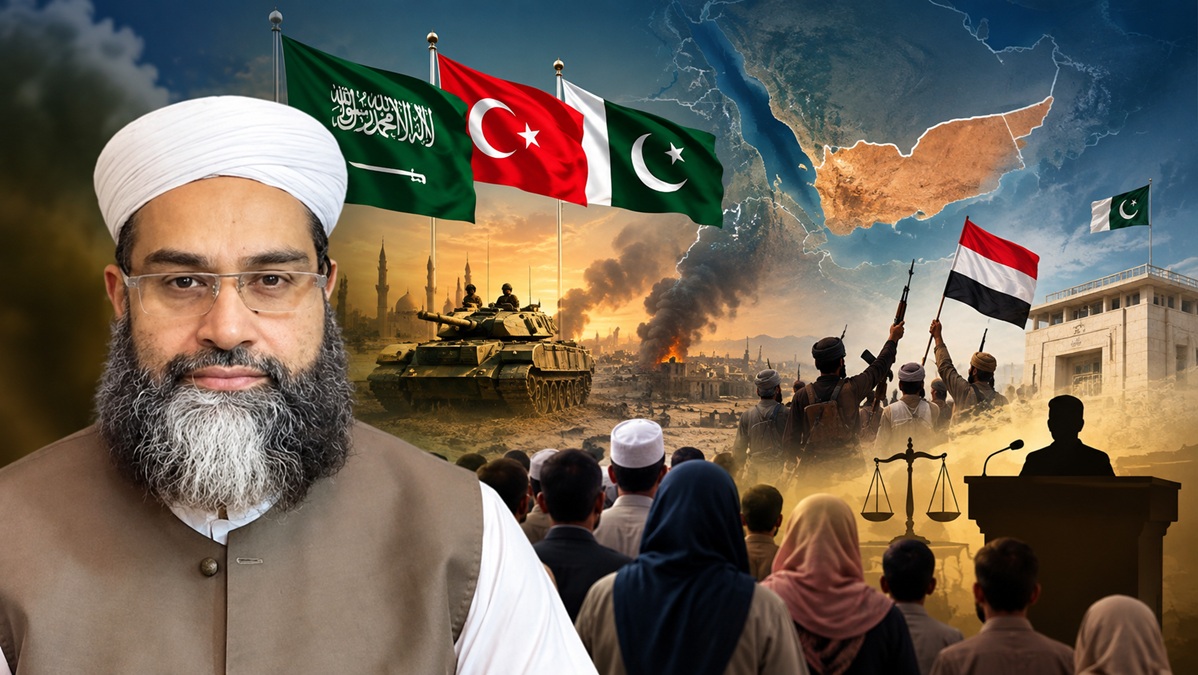
Religious scholar Tahir Mehmood Ashrafi recently labelled Yemen‘s Houthis movement a terrorist group with no real connection to Islam. He’s entitled to that view it’s his opinion to hold and his platform to share it on.
But his comment raises a question far bigger than one cleric’s statement: who actually gets to speak for Pakistan?
Pakistan is home to millions of Muslims across multiple schools of thought, and no single scholar, party, or organization holds a mandate to speak for all of them especially not on a war involving Yemen, Saudi Arabia, Iran, the United States, and Israel, where the stakes reach well beyond Pakistan’s own borders.
Why the Houthi Question Matters for Pakistan Right Now
This debate isn’t happening in a vacuum. Pakistan recently deepened its security ties with Saudi Arabia and Turkey through the Makkah Joint Defense Agreement, under which an armed attack on any one of the three countries is treated as an attack on all three. Islamabad has described the pact as purely defensive, not aimed at any specific rival.
That context makes a real foreign-policy debate legitimate. If Pakistan’s leadership sees the Houthis as a threat to Saudi Arabia, they’re free to say so and if defending Saudi territory under the new agreement becomes a live question, that’s squarely a matter for the government and the armed forces to weigh.
What’s different and more troubling is turning a foreign-policy position into a religious ruling. The Houthi conflict isn’t simply a Sunni-Shia dispute, whatever it might look like from a distance. The Houthis frame their fight as resistance to Saudi intervention and outside influence in Yemen; their opponents frame it in starkly different terms. That gap is precisely why this is a political question as much as a religious one, and Pakistan has paid a steep price before for letting foreign conflicts bleed into domestic religious politics.
Do Pakistani Clerics Speak for the Whole Country?
Not really and that shouldn’t be controversial. Individual scholars represent themselves, their institutions, and sometimes a particular school of thought. Pakistan’s Constitution itself acknowledges this plurality, recognizing different Muslim sects within its Islamic provisions and creating the Council of Islamic Ideology as an advisory not a legislative body.
Also Read:
Yemen Warns Houthis Are Trying to Replicate Iran’s Hormuz Strategy in the Red Sea
None of that gives any one cleric the authority to issue a binding national position, and a public declaration from an individual scholar doesn’t shift Pakistan’s actual legal stance on anything. If the state wants to formally designate the Houthis a terrorist organization, that’s a decision that has to run through Pakistan’s own legal and policy framework not through a press statement.
There’s a real risk buried in skipping that step: branding an entire movement “un-Islamic” can quietly convert a geopolitical dispute into a sectarian one at home, and that helps no one.
The Bottom Line
Pakistan can stand firmly with Saudi Arabia without pretending every Pakistani Muslim was consulted on the decision. It can protect a strategic relationship with Riyadh without converting every foreign-policy disagreement into a religious test.
And if the state eventually decides to call the Houthis terrorists, that call should come from the state through its formal institutions not from an individual scholar speaking as though he represents a nation of 250 million people.


