
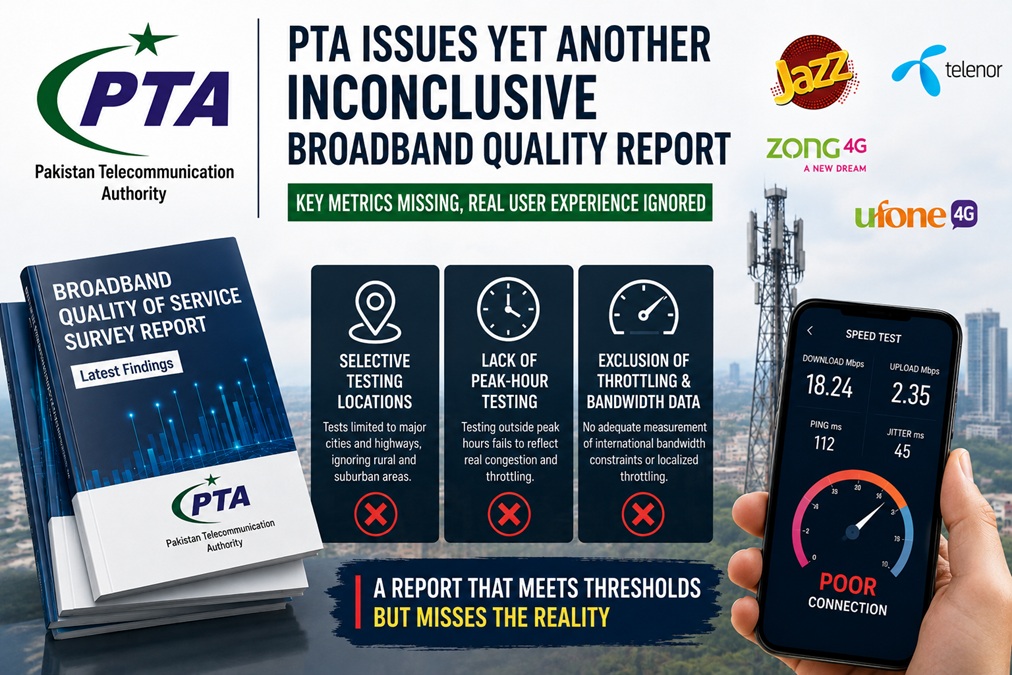
The Pakistan Telecommunication Authority (PTA) has published its latest quality of service survey for fixed and mobile broadband across the country. However, industry observers and digital rights advocates note that the PTA broadband quality report once again falls short of delivering a comprehensive picture of user experience, leaving critical performance metrics unaddressed.
While the regulator routinely conducts these surveys to evaluate internet service providers (ISPs) and cellular mobile operators (CMOs), missing methodologies and narrow sampling continue to raise questions about the report’s real-world accuracy.
What the Latest PTA Quality Survey Covers
According to official details released by the regulator, the survey evaluated primary performance benchmarks across major cities and highways. Key parameters assessed in the audit included:
-
Download & Upload Speeds: Measuring data throughput across 3G, 4G, and fixed broadband networks.
-
Latency & Jitter: Tracking network response times relevant for real-time applications and voice calls.
-
Network Availability & Connection Success: Assessing signal stability and call setup success rates across tested locations.
Despite meeting minimum regulatory thresholds on paper, the aggregated findings contrast sharply with the everyday experiences of Pakistani internet users facing frequent latency spikes and service disruptions.
Also Read:
PTA Reduces eSIM Registration Fee by 50% to Promote Digital SIM Adoption in Pakistan
Key Objections: Why Industry Experts Call It Inconclusive
Telecommunication analysts point out several recurring flaws in the PTA’s quality of service reporting mechanism that hinder transparent evaluation:
-
Selective Testing Locations: Surveys are primarily restricted to major urban centers and main arterial roads, ignoring secondary cities, suburban zones, and rural regions where service quality degrades significantly.
-
Lack of Peak-Hour Testing: Tests are often conducted during non-peak hours, failing to capture severe bandwidth throttling and network congestion experienced by consumers during evening usage.
-
Exclusion of Real-World Throttling Data: The report does not adequately measure international bandwidth constraints, submarine cable degradation impact, or localized content throttling.


