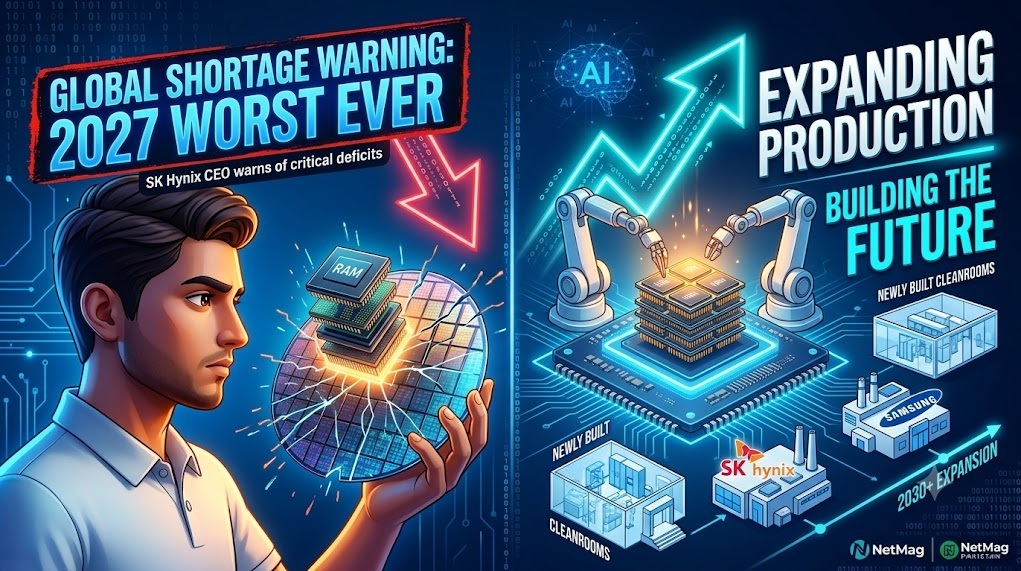
AI Boom Trigger: SK Hynix Warns Global Memory Chip Shortage Will Be Worst Ever in 2027
The tech industry is facing a massive supply threat as the global memory chip shortage is projected to worsen dramatically by 2027. According to SK Hynix CEO Kwak Noh-jung, the upcoming deficit could stand out as the most severe supply crunch in the history of the semiconductor industry, with supply disruptions likely stretching far beyond 2030.
Despite major tech manufacturers aggressively funneling massive capital investments into expanding factories, consumer and enterprise demand continues to heavily outpace maximum production baselines.
Skyrocketing AI Demand Left Production Capacity Stranded
The principal catalyst behind this worsening crisis is the sudden, exponential building of artificial intelligence (AI) data centers around the globe. Advanced hardware frameworks rely heavily on High-Bandwidth Memory (HBM), which is critical for training large-scale language models and driving Nvidia’s leading AI accelerators. Because HBM offers significantly higher profit margins compared to traditional storage components, chipmakers are shifting their primary manufacturing focus away from consumer-tier products.
This manufacturing shift directly threatens the supply chains of mainstream components. NetMag sources indicate that available production lines for DDR4/DDR5 computer memory, smartphone RAM, and NAND flash storage used in standard SSDs will contract sharply. Consequently, everyday hardware prices for laptops, smartphones, and gaming consoles are expected to stay inflated for years.
Multi-Year Supply Contracts Lock Out Smaller Brands
To shield themselves from the incoming global memory chip shortage, tech conglomerates are securing their silicon inventories ahead of time. Major hardware buyers are increasingly signing aggressive multi-year agreements utilizing “take-or-pay” terms, alongside substantial financial deposits to lock in long-term shipments.
Also Read:
How the Global Memory Chip Crisis Hits Pakistani Consumers
While these preemptive agreements guarantee predictable revenues for manufacturers like SK Hynix, they present a major roadblock for smaller independent brands. Smaller PC builders and electronics businesses will find it increasingly difficult to lock down affordable components, further concentrating market control within premium tech networks.
Industry Leaders Race to Construct New Fabs
To mitigate the deficit, major semiconductor brands are deploying long-term infrastructure expansion blueprints:
-
SK Hynix & Samsung: Both tech giants are coordinating with the South Korean government’s massive 800 trillion won semiconductor plan, with goals to double national memory-chip production outputs within five years.
-
Micron Technology: The US-based chip manufacturer has accelerated its local investments to over $250 billion, targeting the production of 40% of its DRAM within the United States by 2035.
However, building modern semiconductor fabrication plants (fabs) is a slow process that takes several years to construct, install specialized machinery, and clear validation stages. Because Micron’s initial facilities are not expected to begin high-volume wafer production until mid-2027, the tech market must brace for severe supply constraints over the next few years.