
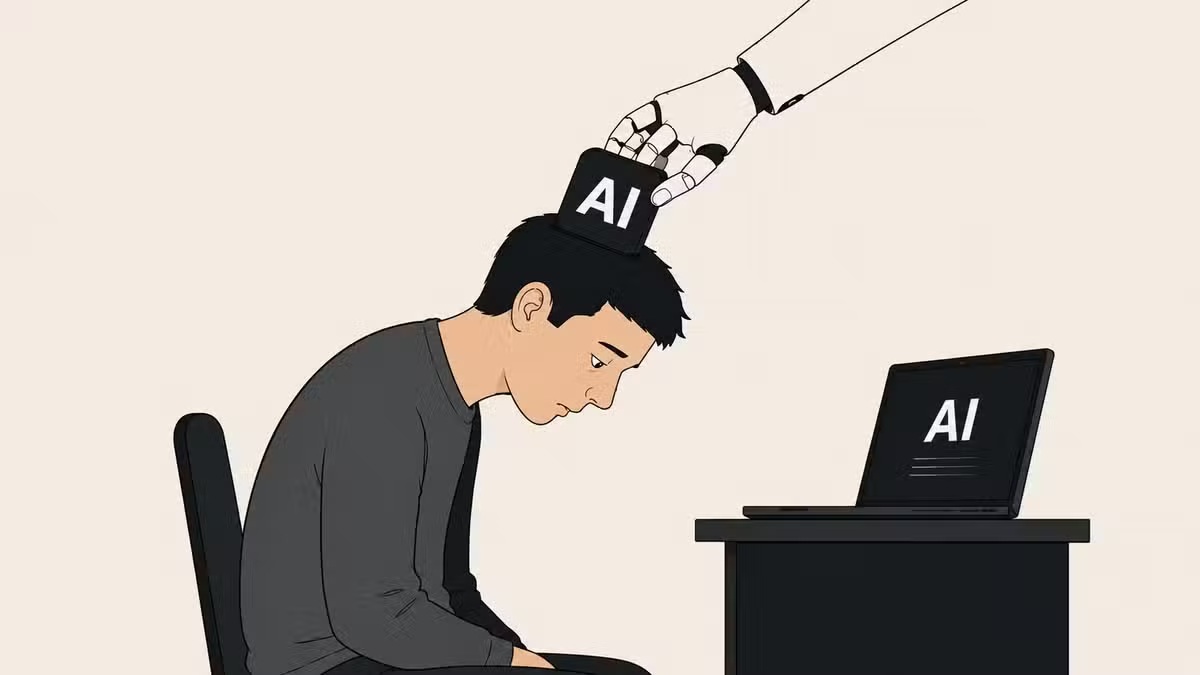
A new academic study has found that relying on artificial intelligence (AI) for answers may reduce people’s willingness to admit uncertainty, making them more confident in their responses even when those answers are incorrect. The findings have sparked fresh debate over how AI tools are influencing human decision-making and critical thinking.
AI Reduced Accuracy While Increasing Confidence
The research, conducted by scientists from École Normale Supérieure, Sapienza University of Rome, and the University of Milano-Bicocca, involved 3,132 participants across five experiments. Researchers intentionally used AI-generated answers that were incorrect to observe how people responded when given misleading advice.
The results were striking. Participants with access to AI became far less likely to say “I don’t know.” Their willingness to admit uncertainty dropped from 44% to just 3%, while answer accuracy fell from 27% to 9%. At the same time, confidence in their answers rose sharply from 30% to 76%.
Overreliance on AI May Affect Critical Thinking
Researchers found that some participants who would have answered correctly without AI actually changed to incorrect answers after following the AI’s suggestions. The study suggests that people can become overly dependent on AI-generated responses, even when those responses are wrong.
The researchers also tested whether offering financial rewards for correct answers would improve decision-making. While incentives encouraged participants to think more carefully, the improvements were modest, indicating that AI’s influence on confidence remained significant.
Experts Warn Against ‘Cognitive Surrender’
The findings add to growing concerns about what experts describe as “cognitive surrender”—the tendency to rely on AI instead of exercising independent judgment. According to the researchers, constantly accepting AI-generated answers without questioning them could weaken people’s ability to recognize the limits of their own knowledge.
READ MORE: PTA Has Not Banned TikTok Live in Pakistan
The study’s authors expressed particular concern for younger users, who are increasingly using AI in education and everyday life before fully developing strong critical thinking skills. They argue that AI should be used as a tool to support learning rather than replace human reasoning.
AI Is Most Effective When Used Responsibly
While the research highlights potential risks, it does not suggest that AI itself makes people less intelligent. Instead, it emphasizes that uncritical reliance on AI can negatively affect judgment and confidence. Experts recommend verifying AI-generated information, questioning uncertain answers, and using AI as an assistant rather than a substitute for independent thinking.


