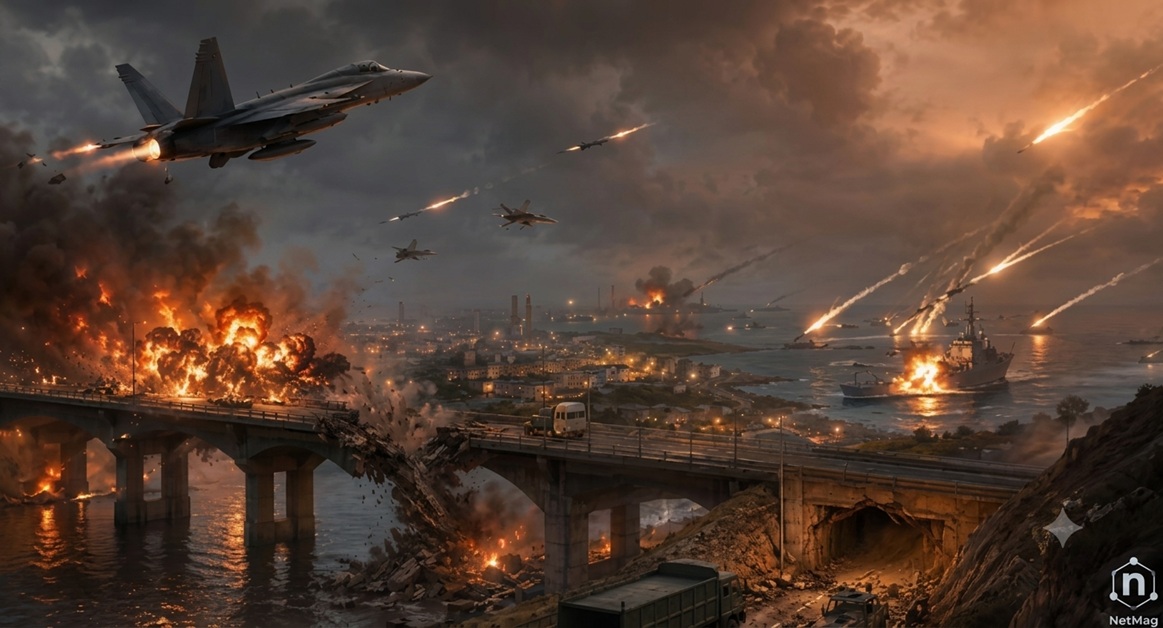
The geopolitical landscape in the Middle East has taken a perilous turn as the conflict over the strategic Strait of Hormuz intensifies. Marking the sixth consecutive night of intensive aerial operations, intense US strikes on Iran infrastructure have severely damaged critical transport networks, bridges, and commercial hubs in southern Iran.
In immediate response, Tehran’s Islamic Revolutionary Guard Corps (IRGC) launched localized drone and missile counter-offensives targeting US military facilities and allied installations across the Persian Gulf. The rapid exchange of fire has completely halted maritime traffic in the world’s most vital energy corridor, sending shockwaves through global oil markets.
Critical Transport and Civil Infrastructure Hammered
According to reports from Iranian state media and independent maritime tracking data, the latest wave of airstrikes executed by US Central Command (CENTCOM) moved beyond purely defensive radar networks to target logistical supply links:
-
Strategic Bridges Hit: At least five critical highway and railway bridges in Hormozgan province were targeted. Strikes on key transport routes in Bandar Khamir resulted in at least seven civilian casualties, severely hindering transit paths connecting the coastal ports to central Tehran.
-
Air and Rail Hubs Disrupted: Heavy damage was reported at the Iranshahr Airport in southeastern Iran, alongside precise missile strikes disrupting the core Bandar Abbas Railway Junction Station.
-
Port Tower Collapse: In the commercial port of Chabahar—a vital maritime trade hub—a main control tower collapsed following overnight bombardment.
CENTCOM officials stated that the operations utilized precision-guided munitions to intentionally degrade Iranian military logistics, coastal surveillance capabilities, and maritime intercept capabilities near Qeshm Island.
Tehran Retaliates Across the Persian Gulf
Refusing to back down under the strain of the updated naval blockade, the IRGC launched coordinated drone swarms and ballistic missiles targeting regional installations hosting American military personnel.
Read More:
U.S. Launches Fresh Strikes on Iran as Oil Tankers Come Under Attack in Strait of Hormuz
Air defense sirens were activated early Friday across several Gulf nations. Authorities in Kuwait, Bahrain, and Qatar confirmed that their air defense systems actively intercepted hostile incoming projectiles over their respective airspaces. Shrapnel damage was reported near residential areas in Doha.
Additionally, the IRGC claimed responsibility for a long-range strike targeting a US special operations command installation in Syria’s al-Tanf region, reporting significant infrastructure destruction.
Naval Blockade Tightens as Oil Prices Surge
Simultaneously, the confrontation at sea is reaching a boiling point. US Navy forces have officially established a strict “steel wall” maritime blockade around major Iranian shipping terminals. CENTCOM confirmed that US Marines successfully boarded the commercial tanker M/T Wen Yao in the Gulf of Oman to verify compliance, while three other merchant vessels attempting to breach the perimeter were forcibly redirected.
In response to the total closure of the Strait of Hormuz, global crude oil prices surged by over 10% in a matter of days, trading near $85 a barrel. With international human rights organizations warning that broad civilian infrastructure destruction could carry heavy legal consequences, regional actors including China and Pakistan have issued urgent diplomatic calls demanding an immediate ceasefire and a return to back-channel peace negotiations.