
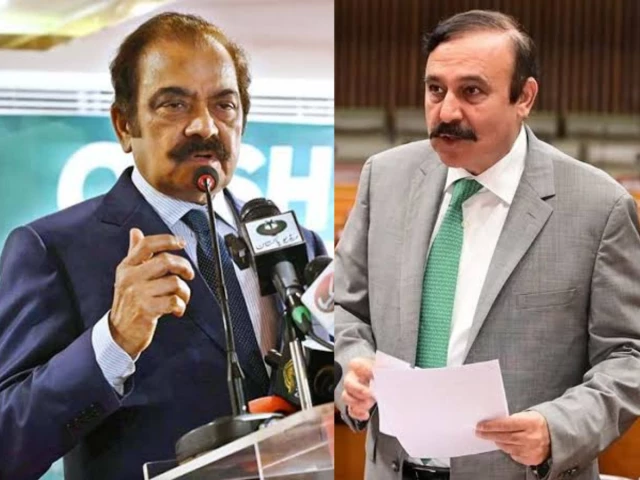
The federal government has urged all political parties in Pakistan to set aside their political differences and develop a joint strategy to combat terrorism, stressing that national security requires cooperation across the political spectrum.
Prime Minister’s Adviser on Political Affairs Rana Sanaullah made the appeal while speaking in the Senate on October 20, 2026. He said Prime Minister Shehbaz Sharif was prepared to invite political leaders for discussions if they could agree on a common approach to counterterrorism.
Sanaullah described terrorism as a national issue that should not be overshadowed by political disagreements. He also referred to the consensus that preceded previous security operations, including Operation Zarb-e-Azb, as an example of how political cooperation could support a coordinated response.
The appeal comes amid tensions between the federal government and opposition parties, particularly Pakistan Tehreek-e-Insaf (PTI), over security policy in Khyber Pakhtunkhwa (K-P).
Rana Sanaullah Offers Talks on Counterterrorism
Addressing the Senate, Sanaullah called on political parties to come together and discuss a unified approach to addressing the country’s security challenges.
He said the prime minister remained willing to engage with political stakeholders if they could reach an agreement on counterterrorism measures.
According to Sanaullah, a joint discussion could help establish a policy supported by political parties and strengthen coordination between the federal government and provincial administrations.
He also urged Jamiat Ulema-e-Islam-Fazl leader Maulana Abdul Wasey to communicate with party chief Maulana Fazlur Rehman regarding the possibility of political engagement.
The government has argued that a coordinated response is necessary to address militant violence and improve cooperation among institutions responsible for security.
Disagreement Over Counterterrorism Policy in Khyber Pakhtunkhwa
A central issue in the current political dispute is the approach to counterterrorism in Khyber Pakhtunkhwa, where security concerns have intensified.
Sanaullah criticised the K-P government’s cooperation with the federal authorities, arguing that provincial-level coordination was necessary for effective counterterrorism efforts.
He contrasted the situation in K-P with Balochistan, where he said the provincial government was cooperating with the federal government and the armed forces.
Sanaullah also referred to provincial apex committee meetings, which provide a forum for officials and security representatives to discuss law-and-order matters.
His remarks reflect the federal government’s position that security operations require cooperation between the centre and provincial administrations.
However, the broader dispute also involves questions about consultation, political authority, and how counterterrorism policies should be developed and implemented. Opposition representatives have maintained that security measures in K-P should involve the provincial government and relevant political stakeholders.
READ MORE: Pakistan Telecommunication Amendment Bill 2026 Reintroduced in Senate
Government and Opposition Differ Over Negotiations
Sanaullah said negotiations between the government and opposition had progressed on several issues but ultimately failed to produce an agreement on support for counterterrorism operations.
According to his account, the parties had discussed arrangements for meetings, outstanding political matters, and the possibility of establishing a committee to address unresolved issues.
He claimed that disagreement over counterterrorism commitments prevented the negotiations from moving forward.
PTI representatives, however, have offered a different explanation for the breakdown in talks. They have argued that the federal government did not accept their demand for a jointly developed counterterrorism policy involving the provincial administration and other political stakeholders.
The competing accounts highlight the continuing disagreement over how security policy should be formulated and what role provincial authorities and opposition parties should play.
Neither side’s explanation should be treated as an agreed account of the negotiations.
Government Calls for Cooperation From Political Leaders
During his Senate address, Sanaullah also criticised the opposition’s engagement with the government through parliamentary channels.
He referred to his interactions with Senate Opposition Leader Raja Nasir Abbas and questioned the opposition’s willingness to meet government representatives.
Sanaullah urged opposition leaders to move beyond political disagreements and participate in discussions on security.
He also recalled previous negotiations with PTI over electoral arrangements and other political matters, arguing that earlier opportunities for agreement had not produced lasting progress.
The remarks illustrate how disagreements over counterterrorism have become connected with wider disputes between the government and opposition.
The government maintains that political engagement is necessary to build consensus on security, while opposition leaders have raised concerns about the terms and conditions under which such engagement should take place.
Security Concerns Increase Pressure for a Joint Strategy
The government’s appeal comes amid reports of increasing militant violence across parts of Pakistan.
According to figures cited in recent security reporting by the Centre for Research and Security Studies, Pakistan recorded 1,415 violence-linked fatalities across 385 incidents during the third quarter of 2026. The reported fatalities represented an 83% increase compared with the previous quarter.
Khyber Pakhtunkhwa and Balochistan have remained major areas of concern, with security incidents placing pressure on law-enforcement agencies and other institutions.
The worsening situation has renewed calls for improved coordination, intelligence sharing, and cooperation between federal and provincial authorities.
A political consensus could help establish clearer priorities and provide a framework for consultation on security measures. However, the practical impact would depend on the substance of any agreement and how it was implemented.
Previous Political Consensus on Security Operations
Sanaullah referred to Operation Zarb-e-Azb as an example of a major security initiative launched with broad political support.
The operation, launched in 2014, formed part of Pakistan’s efforts to address militant activity, particularly in the former tribal areas.
His reference was intended to underline the government’s argument that political consensus can help support national security initiatives.
Political agreement does not eliminate differences over operational decisions, civilian protection, or the responsibilities of federal and provincial authorities. However, dialogue can provide a mechanism for discussing these concerns and establishing common objectives.
The current debate centres on whether political parties can reach a similar understanding on the security challenges facing Pakistan today.
What Happens Next?
The government’s latest appeal places renewed emphasis on dialogue as a possible way to resolve disagreements over counterterrorism policy.
Prime Minister Shehbaz Sharif has been presented by Sanaullah as willing to invite political stakeholders if they can agree to discuss the issue collectively.
For progress to occur, the government and opposition would need to address their competing positions on provincial cooperation, security operations, and the role of political consultation.
Further discussions could help clarify the areas where agreement is possible, although no new all-party consensus had been announced at the time of Sanaullah’s Senate address.
The immediate challenge remains whether political leaders can separate their wider disputes from the question of how to respond to terrorism.
Conclusion
The federal government has called on all political parties to put aside their differences and work towards a common counterterrorism strategy.
Speaking in the Senate on October 20, Rana Sanaullah said Prime Minister Shehbaz Sharif was prepared to invite political leaders for talks if they could reach an agreement on security policy.
The appeal comes amid disagreements between the government and PTI over counterterrorism measures in Khyber Pakhtunkhwa and the role of provincial authorities in developing security policy.
Although both sides have presented different explanations for the failure of recent negotiations, the government’s latest statement has renewed the possibility of dialogue.
Whether the initiative leads to a broader political agreement will depend on the willingness of the parties to engage and resolve their differences over the country’s security strategy.


