
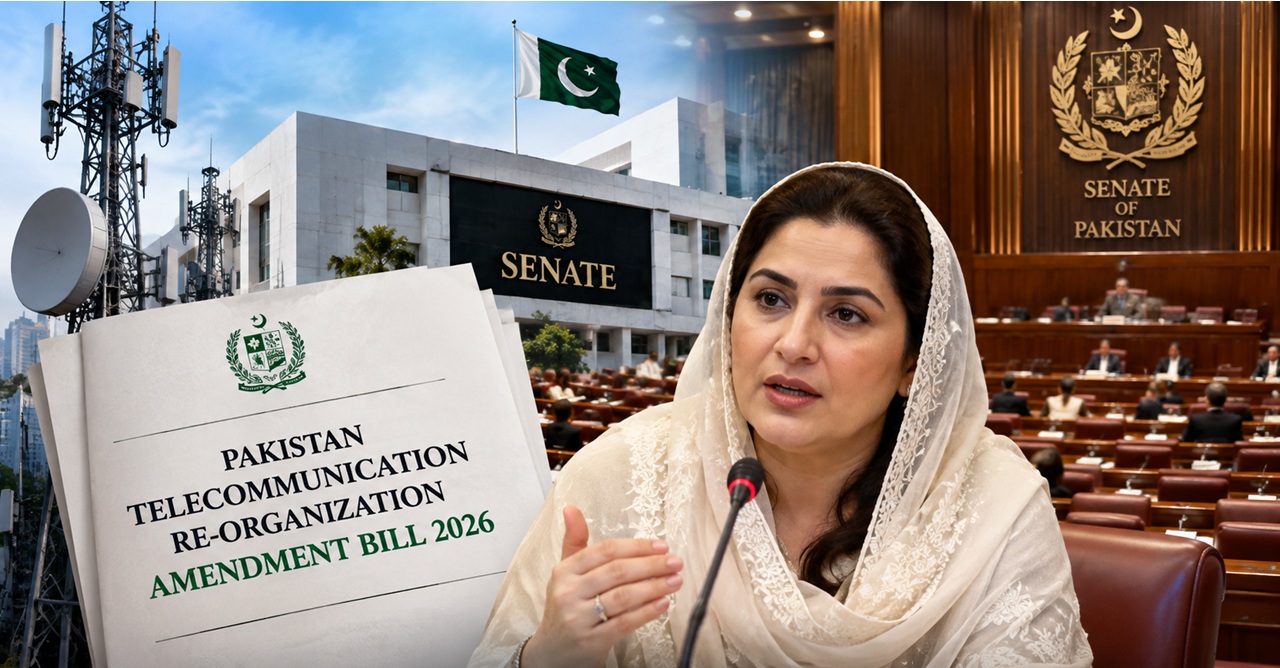
The Pakistan Telecommunication (Re-Organization) Amendment Bill 2026 has been reintroduced in the Senate, reopening parliamentary discussions on reforms aimed at improving the deployment of telecommunications infrastructure across the country.
Senator Samina Mumtaz Zehri introduced the proposed legislation as a private member’s bill during the Senate’s Private Members’ Day on October 20, 2026. Following its introduction, the Senate chairman referred the bill to the Senate Standing Committee on Information Technology and Telecommunication for further examination.
The development comes nearly two months after the federal government withdrew its earlier version of the bill from the Senate following concerns over its provisions, particularly those relating to right-of-way access and private property rights.
The latest move brings the proposed amendments back into the parliamentary process. However, the bill has not been approved, and further scrutiny will be required before it can progress through the legislative process.
Telecom Amendment Bill Returns to Senate
The reintroduction marks another attempt to amend the Pakistan Telecommunication (Re-Organization) Act, 1996, which provides the legal framework for the country’s telecommunications sector and the Pakistan Telecommunication Authority (PTA).
The proposed legislation is intended to address challenges associated with deploying telecommunications infrastructure, including fibre-optic cables, towers, and other network equipment.
Telecom operators have long faced difficulties obtaining right-of-way permissions for infrastructure projects. Delays in approvals, differing requirements across jurisdictions, and associated costs can slow network expansion and increase deployment expenses.
The bill’s return to the Senate provides lawmakers with another opportunity to examine the proposed legal framework and consider how telecom infrastructure development can be facilitated while protecting property owners’ rights.
READ MORE: Gold Prices Fall Sharply in Pakistan: Check Latest Rates for October 20, 2026
Why the Government Withdrew the Earlier Bill
The federal government withdrew its earlier version of the Pakistan Telecommunication Amendment Bill on August 28, 2026.
The government said it intended to introduce fresh legislation to avoid delays and move the legislative process forward while retaining the essence of the proposed reforms.
The earlier bill had passed the National Assembly in June before being referred to the Senate. However, it faced objections during parliamentary scrutiny, particularly over provisions concerning telecom operators’ access to public and private property.
Some lawmakers questioned whether the proposed arrangements offered sufficient safeguards for property owners. Concerns were also raised about provisions that could potentially allow a lack of response to official notices to be interpreted as consent for infrastructure installation.
These objections contributed to delays in the Senate and prompted calls for further examination of the proposed legislation.
The government’s withdrawal of its version did not end discussions about telecom right-of-way reform. Instead, it created an opportunity to reconsider the legislative approach.
What Is Right of Way in Telecommunications?
Right of way, commonly known as RoW, refers to the permissions and legal arrangements required to install, maintain, or access telecommunications infrastructure on or across land.
Telecom operators need these permissions to lay fibre-optic cables, install network equipment, and extend connectivity to residential areas, businesses, and public institutions.
Obtaining approvals can become complicated when projects involve multiple authorities, housing societies, local administrations, or private property owners.
A more consistent legal framework could help reduce administrative delays and make infrastructure deployment more predictable for telecom companies.
However, right-of-way rules must also establish clear safeguards for property owners, including appropriate consent procedures, dispute-resolution mechanisms, and responsibilities for repairing any damage caused during installation work.
The latest bill will be examined by the Senate’s IT and Telecommunication Committee, where lawmakers can consider the proposed framework and its implications.
How the Bill Could Affect Internet and Mobile Services
The proposed legislation is relevant to Pakistan’s broader digital connectivity ambitions, including the expansion of fibre networks and the development of next-generation mobile services.
Telecommunications infrastructure requires more than mobile spectrum. Operators also need reliable fibre connections, suitable network sites, and supporting infrastructure to provide consistent connectivity.
Fibre-optic networks carry large volumes of data between mobile sites and the wider telecommunications network. Delays in deploying these connections can affect network expansion and the ability to improve service capacity.
A clearer right-of-way framework could help operators plan infrastructure projects more efficiently, potentially reducing some of the obstacles associated with network deployment.
For consumers, successful reforms could eventually support better internet availability, stronger network capacity, and more reliable mobile services. However, any improvement would depend on the final legislation, its implementation, operator investment, and other technical and commercial factors.
The bill’s reintroduction alone does not guarantee immediate improvements in internet speeds or mobile coverage.
Private Property Rights Remain a Key Concern
One of the most contentious aspects of the earlier legislation was how telecom operators could obtain access to land for infrastructure development.
Lawmakers and other stakeholders raised questions about the protection of private property rights and the procedures for resolving disagreements between operators and property owners.
The Ministry of Information Technology and Telecommunication previously stated that the proposed right-of-way framework did not authorise compulsory acquisition of private land or permit operators to enter individual private property without the owner’s permission or due legal process.
Nevertheless, the earlier bill’s provisions faced scrutiny in Parliament, and the government subsequently withdrew its version.
As the legislation returns through a private member’s initiative, its specific provisions will need to be examined carefully. The details currently available do not establish whether the new version retains, removes, or modifies the contentious clauses from the earlier draft.
The Senate committee’s review will be an important stage in determining how the proposed amendments address infrastructure requirements while safeguarding property owners.
Senate Committee to Examine the Proposed Legislation
Following its introduction, the bill was referred to the Senate Standing Committee on Information Technology and Telecommunication.
The committee will be responsible for examining the proposed amendments and considering the issues raised by lawmakers and relevant stakeholders.
Committee deliberations can help clarify the legislation’s scope, identify provisions that may require changes, and assess the potential implications for telecom operators and property owners.
The referral does not mean that the Senate has approved the bill. Further legislative consideration is required before the proposed amendments can become law.
The outcome will depend on the committee’s examination and the subsequent parliamentary process.
What Happens Next?
The immediate next step is the Senate committee’s review of the reintroduced bill.
Lawmakers will need to examine the proposed amendments and consider whether the legislation provides an effective framework for resolving right-of-way challenges without weakening legal protections for property owners.
If the bill progresses, it will still need to complete the applicable legislative stages before becoming law.
For Pakistan’s telecom industry, the central question is whether the proposed reforms can create a more predictable process for deploying infrastructure while ensuring transparency, accountability, and appropriate safeguards.
The outcome could have implications for fibre expansion, mobile network development, and future connectivity projects across the country.
Conclusion
Pakistan’s Telecommunication Amendment Bill 2026 has returned to the Senate through a private member’s initiative by Senator Samina Mumtaz Zehri. The proposed legislation has been referred to the Senate Standing Committee on IT and Telecommunication for further review.
The development follows the federal government’s withdrawal of its earlier version in August amid concerns over right-of-way arrangements and private property rights.
The proposed reforms seek to address challenges associated with telecommunications infrastructure deployment, which is important for improving connectivity and supporting future network expansion.
However, the bill remains under consideration. Its eventual impact will depend on the provisions retained in the legislation, the outcome of parliamentary scrutiny, and how any approved changes are implemented.


