
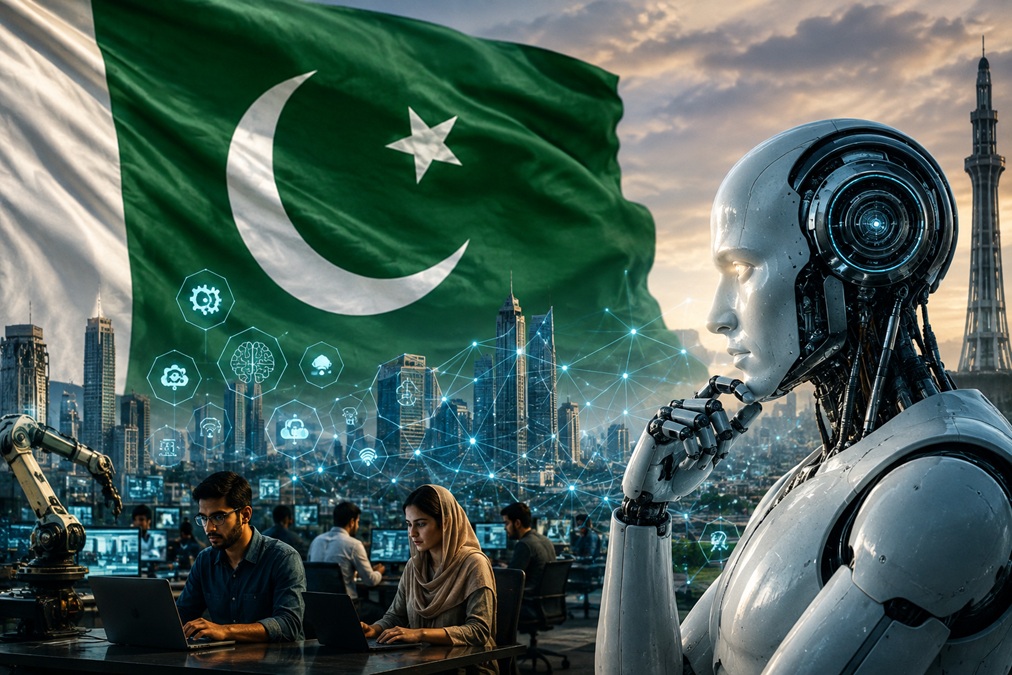
Pakistan could face significant employment challenges as artificial intelligence (AI) transforms industries worldwide, according to the World Development Report 2026 released by the World Bank. The report identifies Pakistan as one of the countries most vulnerable to AI-driven job displacement, while highlighting the enormous gap between global AI investments and the country’s economic capacity.
The World Bank noted that the combined 2026 capital expenditure of five major U.S. technology companies—Alphabet, Amazon, Meta, Microsoft, and Oracle—is projected to reach $775 billion, nearly double Pakistan’s estimated nominal GDP of around $408 billion. The scale of this investment underscores how rapidly AI infrastructure is expanding globally and the challenges developing economies face in keeping pace.
Pakistan Faces Growing AI Employment Risks
The report warns that Pakistan’s economy relies heavily on sectors that could be affected by automation, including business process outsourcing (BPO), customer support, software services, and administrative work. Many entry-level and routine knowledge-based jobs are increasingly being performed by AI-powered systems, raising concerns about future employment opportunities for young professionals.
Also Read:
Pakistan Making Rapid Progress in Robotics and AI, Says IT Minister Shaza Fatima
However, the World Bank also stresses that AI should not be viewed solely as a threat. If supported by the right policies, AI can improve worker productivity, enhance public services, and create new economic opportunities across healthcare, education, agriculture, and government services.
AI Can Drive Growth With the Right Policies
According to the report, developing countries have more to gain and less to fear from AI than advanced economies because a smaller share of their workforce is directly exposed to automation. While around 14.2% of jobs in high-income countries face automation risks, the figure is estimated at 4.5% for developing economies. Instead, AI is expected to complement workers by helping them perform more advanced tasks and increasing productivity.
To maximise AI’s benefits, the World Bank recommends that Pakistan invest in:
- Digital infrastructure and reliable electricity
- Affordable broadband internet
- AI and digital skills training
- Access to smartphones and computing devices
- Innovation-friendly regulations
- Local AI research and development
These measures, the report says, will help prepare Pakistan’s workforce for the digital economy while reducing the risks associated with automation.
Bridging the AI Gap
Experts believe Pakistan still has an opportunity to benefit from AI if policymakers prioritise digital transformation, workforce reskilling, and innovation. Rather than competing in the race to build massive AI infrastructure, the country can focus on adopting cost-effective AI solutions tailored to local needs in sectors such as agriculture, education, healthcare, and public administration.
The World Bank concludes that AI could become a powerful driver of economic growth for developing nations—but only if governments act quickly to strengthen digital infrastructure, improve education, and prepare workers for the changing nature of employment.


