
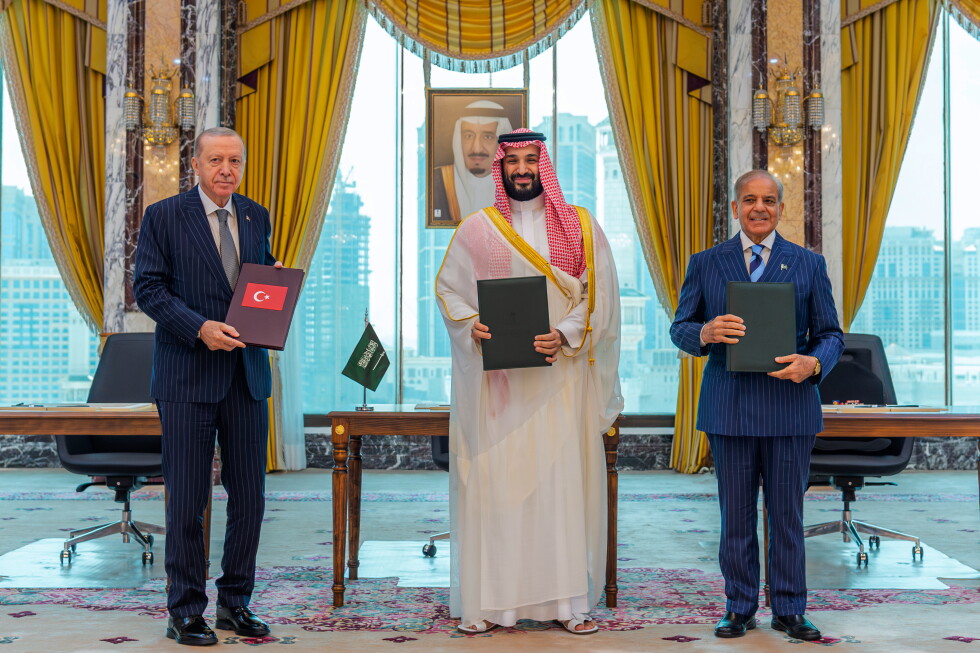
Türkiye has submitted the Makkah Joint Defence Agreement with Pakistan and Saudi Arabia to its parliament for ratification, marking another step towards formalising defence cooperation among the three countries amid escalating regional security concerns.
The agreement, signed on August 7, 2026, in Makkah, establishes a framework for mutual defence cooperation. Under its provisions, an armed attack against one member would be treated as an attack against all three, with each country assessing the assistance it can provide.
According to Reuters reporting published on October 20, the agreement provides for cooperation in intelligence sharing, defence industries, logistics, counterterrorism and military support.
The move comes as Saudi Arabia faces reported attacks on civilian facilities and energy infrastructure attributed to Yemen’s Houthi movement.
What does the agreement mean?
The agreement seeks to strengthen collective deterrence and coordination between Pakistan, Saudi Arabia and Türkiye. Its provisions resemble the collective-defence principle associated with NATO, although the pact operates under its own terms and does not make the three countries NATO members.
The text provides for assistance using the range of measures available to the signatories. Each country would assess the nature and extent of the support required and the resources it could provide.
The agreement also covers cooperation in defence technology, joint training, research, logistical support and intelligence sharing.
READ MORE: Pakistan Continues US–Iran Mediation as Tehran Sticks to Conditions for Talks
Will Türkiye send troops to Saudi Arabia?
Türkiye’s submission of the agreement to parliament is an important procedural step, but it does not itself confirm a troop deployment.
Reuters reported that Turkish parliamentary approval is being pursued for the defence pact. A separate mandate would be required for the deployment of Turkish military personnel abroad.
Turkish officials have described the agreement as defensive. They have also indicated that Türkiye’s possible contribution could include military equipment, intelligence and defence systems. The precise scale of any future assistance has not been publicly established.
Claims that the agreement has already resulted in a large-scale deployment of Pakistani or Turkish combat forces should therefore not be presented as confirmed without additional official evidence.
Pakistan’s role in regional security
Pakistan brings extensive military experience and an established security relationship with Saudi Arabia, while Türkiye has a substantial defence industry and NATO membership. Saudi Arabia contributes significant financial resources and strategic regional influence.
The agreement provides a framework for these capabilities to be coordinated, although its practical implementation will depend on the decisions of the participating governments.
For Pakistan, the development comes at a sensitive time. Escalating attacks in the Gulf could affect regional stability, energy supplies, shipping routes and the economic interests of countries that rely on imported fuel.
Islamabad will also need to balance its security partnerships with its wider diplomatic interests, including efforts to reduce tensions across the Middle East.
What happens next?
Türkiye’s parliament must proceed with the relevant ratification process. The agreement’s entry into force depends on the deposit of ratification documents in accordance with its terms.
Further announcements from the three governments will be needed to establish whether specific military assistance, joint deployments or additional operational measures have been approved.
NetMag assessment: The defence agreement represents a significant framework for cooperation among Pakistan, Saudi Arabia and Türkiye. However, parliamentary ratification, the agreement’s formal entry into force and any actual troop deployment are separate matters and should be reported distinctly.


